The AI Testing Pyramid
Build Trust in AI Systems Through Structured, Enterprise-Grade Validation
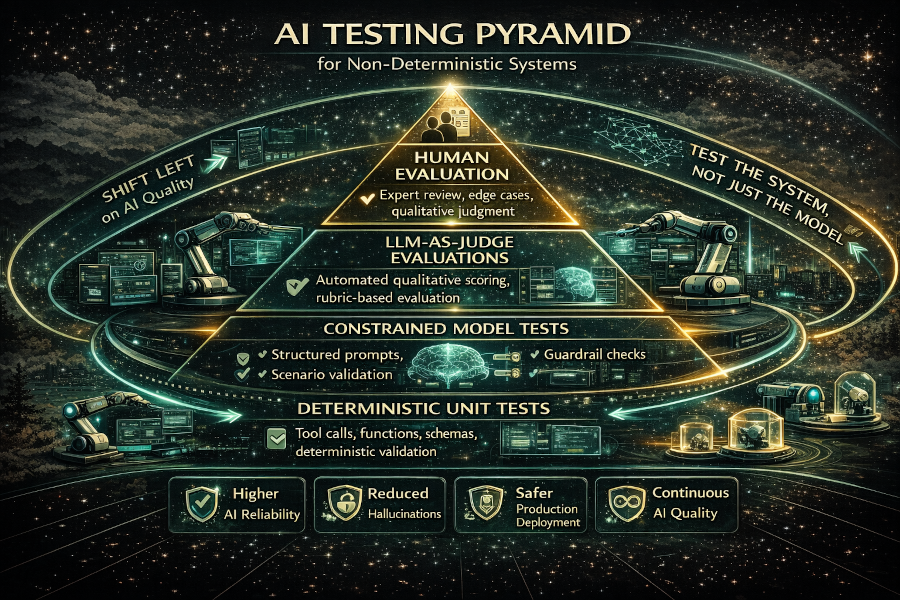
AI introduces a fundamentally different testing challenge from traditional software. Large Language Models are inherently non-deterministic—two identical prompts may produce different, yet equally valid, outputs. Traditional testing approaches that rely on exact expected results simply do not provide the confidence organizations need when deploying AI into critical business processes.
Asperitas' AI Assurance Factoryprovides a practical, scalable methodology for validating AI systems using our proven AI Agent Testing Pyramid. The framework enables organizations to establish quality, reliability, governance, and operational confidence while balancing testing cost, execution speed, and business risk.
Our approach combines automated testing, AI-based evaluation techniques, and human oversight to create an enterprise-ready quality assurance process for AI applications, agents, and autonomous workflows.
Level 1: Deterministic Unit Tests
Fast, Cheap, Continuous Validation
The foundation of effective AI testing lies in deterministic components that can be validated using traditional software engineering techniques while mocking the underlying LLM. Detailed information on Level 1 Deterministic Unit Tests
Areas of validation include:
- Agent orchestration logic
- Tool invocation and routing
- State and memory management
- Error handling and recovery processes
- Input validation and output formatting
- Business rules and guardrails
These tests execute in milliseconds, require no model API calls, and provide clear pass/fail signals that can be integrated into continuous integration pipelines.
Level 2: Constrained Model Tests
Validating Behavior Within Controlled Boundaries
The second layer introduces real model interactions while limiting variability through carefully designed prompts, fixed contexts, and narrowly defined evaluation criteria. Detailed information on Level 2 Constrained Model Tests
This level verifies:
- Prompt effectiveness
- Structured output generation
- Retrieval accuracy
- Tool selection behavior
- Workflow reliability under expected conditions
Constrained testing provides confidence that agents operate correctly within the boundaries of their intended use cases while keeping testing costs reasonable.
Level 3: LLM-as-Judge Evaluations
Scalable Quality Assessment for Non-Deterministic Systems
Traditional assertions become increasingly difficult as AI systems tackle open-ended problems. LLM-as-Judge evaluations leverage specialized evaluation models to assess outputs against business-defined criteria.
Evaluation dimensions include:
- Factual correctness
- Relevance and completeness
- Policy and compliance adherence
- Hallucination detection
- Decision quality
- ustomer experience expectations
This approach enables organizations to automate large-scale behavioral testing while producing measurable quality metrics across thousands of scenarios.
Level 4: Human Evaluation
The Final Layer of Enterprise Assurance
Human judgment remains essential for high-impact business decisions, nuanced customer interactions, and strategic AI use cases.
Human evaluations focus on:
- Business appropriateness
- Regulatory compliance
- Ethical considerations
- Brand alignment
- User experience quality
- High-risk decision validation
By concentrating human oversight where it delivers the greatest value, organizations can maximize confidence without introducing unnecessary operational costs.
The Asperitas AI Assurance Factory
The AI Agent Testing Pyramid serves as a foundational component of the Asperitas AI Assurance Factory, a comprehensive framework for validating, governing, and continuously improving enterprise AI systems.
The AI Assurance Factory provides:
- AI testing strategy and implementation
- Automated evaluation pipelines
- Continuous quality monitoring
- Governance and compliance controls
- Observability and operational metrics
- Human review workflows
- Risk-based deployment processes
- Enterprise-ready reporting and auditability
This approach enables organizations to move beyond experimentation and establish repeatable, scalable, and trustworthy AI operations.
Service Offerings
AI Testing Strategy & Assessment
We evaluate your current AI development practices, identify quality gaps, and define an enterprise testing strategy aligned with your risk profile and business objectives.
AI Evaluation Framework Implementation
Our consultants implement automated testing frameworks, evaluation pipelines, scoring mechanisms, and continuous validation processes tailored to your AI applications.
AI Assurance Factory Enablement
We help organizations operationalize AI quality assurance through governance processes, monitoring capabilities, human evaluation workflows, and ongoing optimization.
Managed AI Testing Services
For organizations seeking ongoing support, Asperitas provides managed testing and evaluation services to continuously validate AI systems as models, prompts, and business requirements evolve.
Business Benefits
Organizations implementing the AI Agent Testing Pyramid achieve:
- Higher confidence in production AI deployments
- Reduced risk of hallucinations and unintended behaviors
- Faster AI delivery cycles through automated validation
- Improved governance and auditability
- Lower operational testing costs
- Clear quality metrics for business stakeholders
- Scalable human oversight processes
- Greater trust from customers, regulators, and internal teams
Enterprise AI Requires Enterprise Assurance
As AI systems take on increasingly consequential work, organizations need testing strategies tailored to non-deterministic systems. The AI Agent Testing Pyramid provides a practical framework for balancing speed, cost, automation, and human judgment, enabling enterprises to deploy AI with confidence.
Contact Asperitas to learn how our AI Assurance Factory can help your organization establish a robust, scalable approach to AI quality and governance.